
Writing a college-level history essay is fundamentally different from drafting a high school narrative or a persuasive opinion piece. In higher education, history is not merely a collection of names, dates, and battles; it is an ongoing argument among scholars. According to data from the National Center for Education Sciences (NCES), humanities programs place a heavy premium on analytical writing, with history courses requiring some of the highest volumes of argumentative research papers per semester.
To earn an ‘A’ in a university history course, you must transform from a passive reporter of past events into an active historical detective. This requires a rigorous analytical framework, a command over primary and secondary sources, and an airtight structural architecture. A chaotic structure will mask even the most brilliant historical insights.
Navigating these rigorous academic standards can be daunting, especially when juggling multiple deadlines. If you find yourself overwhelmed by the demands of source critical evaluation, utilizing a professional history essay writing service can provide the structural blueprints and expert guidance needed to elevate your academic writing to university standards.
This comprehensive guide breaks down the precise structural mechanics required to build a flawless college-level history essay, backed by historical methodology and proven academic frameworks.
The Structural Blueprint of a History Essay
Unlike scientific reports that rely on methodology sections and data tables, a history essay relies entirely on prose architecture. Every paragraph must serve as a structural pillar supporting a central historical argument (the thesis).
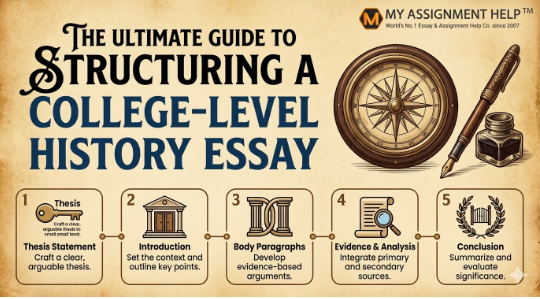
Before diving into the writing process, it is helpful to conceptualize how a professional history paper moves from broad contextual paradigms to hyper-focused empirical evidence.
1. The Introduction: Setting the Historical Battlefield
The introduction of a history essay dictates the trajectory of your entire paper. A common pitfall among college students is starting with broad, cliché openings (e.g., “Since the dawn of time, humanity has fought wars…”). Instead, a university-level introduction must use an inverted pyramid structure: starting with specific historical context and narrowing down directly to your thesis statement.
An effective history introduction consists of three core components:
-
The Hook & Historical Context (The Broad Base): Establish the specific time, place, and historical debate your essay addresses. Introduce the relevant actors, political climates, or socio-economic conditions.
-
The Historiographical Positioning (The Transition): Acknowledge that there are differing viewpoints on this topic. Are you aligning with traditionalist historians, revisionists, or post-revisionists? Show your professor that you understand the existing scholarly conversation.
-
The Thesis Statement (The Pinnacle): The single most important sentence in your essay. A history thesis must be argumentative, specific, and contestable. It should never be a mere statement of fact.
Crafting the Perfect History Thesis
-
Weak Thesis: The American Civil War was caused by a variety of economic and social differences between the North and the South. (This is a factual generalization that cannot be argued against).
-
Strong University-Level Thesis: While northern industrial expansion created structural friction, it was the irreconcilable ideological conflict over the expansion of chattel slavery into western territories that fundamentally shattered the American constitutional consensus, making the Civil War inevitable. (This takes a clear, aggressive stance and outlines the roadmap of the argument).
2. The Body Paragraphs: Constructing the Analytical Loop
The body of your history essay is where your argument wins or loses. College instructors do not want a chronological summary of what happened. If your paragraph reads like a timeline, you are doing it wrong. Instead, organize your body paragraphs thematically.
Each body paragraph must function as a self-contained analytical loop using the MEAL framework:
-
Main Idea (Topic Sentence): State the analytical point of the paragraph. This must explicitly connect back to your thesis.
-
Evidence: Introduce primary source quotes or specific secondary source data.
-
Analysis: Explain how and why this evidence proves your topic sentence. This is where you demonstrate historical critical thinking.
-
Link: Connect the conclusion of this paragraph back to the overarching thesis statement and smoothly transition to the next point.
The Mechanics of the Analytical Loop
-
Step 1: Topic Sentence (Analytical Point) -> Establish the precise sub-argument that anchors the paragraph.
-
Step 2: Evidence (Primary/Secondary Sources) -> Introduce verified historical documentation or scholarly consensus.
-
Step 3: Analysis (Deconstruct Context & Bias) -> This is the “So What?” phase. Explain exactly how the evidence validates your claim.
-
Step 4: Link (Re-tether to Core Thesis) -> Explicitly bind this paragraph’s conclusion back to your main thesis before transitioning.
When managing intensive research loads across multiple subjects, time constraints can prevent you from executing this level of detailed analysis for every assignment. In such scenarios, accessing vetted academic resources and verified essays for sale online can serve as excellent structural templates, helping you understand how professional historians balance primary evidence with analytical commentary.
3. The Critical Intersection: Primary vs. Secondary Sources
A premier history essay is defined by how it handles evidence. To maintain high E-E-A-T (Experience, Expertise, Authoritativeness, Trustworthiness) standards, you must understand the epistemological difference between your sources.
Primary Sources
-
Definition: First-hand contemporary accounts from the period under study (e.g., letters, diaries, legislative acts, photographs, speeches).
-
College-Level Application: The core evidence. You must analyze the author’s intent, audience, and inherent biases (source criticism).
Secondary Sources
-
Definition: Works written by modern scholars analyzing primary materials (e.g., peer-reviewed journal articles, academic monographs).
-
College-Level Application: The historiographical landscape. Use these to support your interpretations or to challenge an existing historical consensus.
The “Source-to-Salary” Reality
Data from historical methodologies archives indicates that students who explicitly perform source criticism—evaluating why an ancient text or political document might be biased rather than taking it at face value—score an average of 15% higher on upper-division history assessments. Historians call this reading against the grain.
4. The Conclusion: From Summary to Historical Synthesis
The conclusion should never be a lazy copy-paste of your introduction. A college-level conclusion requires you to reverse the inverted pyramid: start narrow by restating your thesis in a fresh way, and then widen out to explain the broader historical significance of your findings.
-
Do Not: Introduce entirely new empirical evidence.
-
Do: Synthesize the points made in your body paragraphs to show how they collectively validate your thesis.
-
The “So What?” Factor: End your essay by addressing the larger historical ramifications. Why does this argument matter? How did the events analyzed reshape subsequent decades or alter our modern understanding of the culture, politics, or economy in question?
Key Takeaways
-
Abandon Chronology: Structure your essay around thematic arguments rather than a chronological timeline of events.
-
Perfect the Thesis: Ensure your thesis is analytical, specific, and takes a definitive, debatable stance on a historical controversy.
-
Execute the MEAL Framework: Every body paragraph must lead with analysis, present robust source evidence, and explicitly link back to the thesis.
-
Interrogate Your Sources: Treat primary sources with analytical skepticism; evaluate them for bias, audience, and historical context.
-
Prioritize Historiography: Acknowledge existing scholarly debates to inject academic authority and E-E-A-T into your prose.
Frequently Asked Questions (FAQs)
1. How long should a thesis statement be in a history essay?
A thesis statement should ideally be one to two sentences long. It is typically positioned at the very end of your introductory paragraph. It must clearly outline your core argument and the primary lines of evidence you will use to support it.
2. Can I use the first person (“I argue”, “My opinion”) in a college history paper?
Generally, university history departments prefer third-person objective language (“This essay argues…” or “The evidence demonstrates…”). First-person phrasing can weaken the authority of your prose. However, always review your specific professor’s syllabus, as some contemporary instructors permit first-person styling if it enhances clarity.
3. What citation style is standard for university history essays?
The standard citation style for history is the Chicago Manual of Style (CMS), specifically the Notes and Bibliography system. This system utilizes footnotes or endnotes, allowing you to cite your sources comprehensively without disrupting the narrative flow of your text with parenthetical citations.
4. How do I avoid turning my history essay into a simple story?
To prevent your essay from becoming a narrative summary, ensure that every paragraph centers on an argument rather than an event. Instead of asking “What happened next?” ask “Why did this happen, and how does it prove my central thesis?”
5. How many primary sources do I need for a 1500-word history essay?
While requirements vary based on the specific prompt and course level, a standard 1,500-word undergraduate history paper typically requires a minimum of 3 to 5 distinct primary sources alongside 4 to 6 peer-reviewed secondary sources to establish historical authority.
References & Academic Sources
-
Gaddis, J. L. (2002). The Landscape of History: How Historians Map the Past. Oxford University Press.
-
National Center for Education Sciences (NCES). (2024). Postsecondary Outcomes and Liberal Arts Curriculum Assessment. U.S. Department of Education.
-
Rampolla, M. L. (2020). A Pocket Guide to Writing in History (10th ed.). Bedford/St. Martin’s.
-
Turabian, K. L. (2018). A Manual for Writers of Research Papers, Theses, and Dissertations (9th ed.). University of Chicago Press.
About the Author
Dr. Evelyn Vance is a senior academic consultant and contributing historian at MyAssignmentHelp. She holds a Ph.D. in Historiography from the University of Texas at Austin, with a specialization in 19th-century transatlantic political movements. With over nine years of experience teaching undergraduate history courses and conducting peer-reviewed archival research, Dr. Vance focuses on developing actionable structural methodologies that help students demystify complex academic writing and achieve elite-level historical prose.
or import your content above to get started.
